


Watching Agamemnon
October 24, 2024 | by Bridget Webster
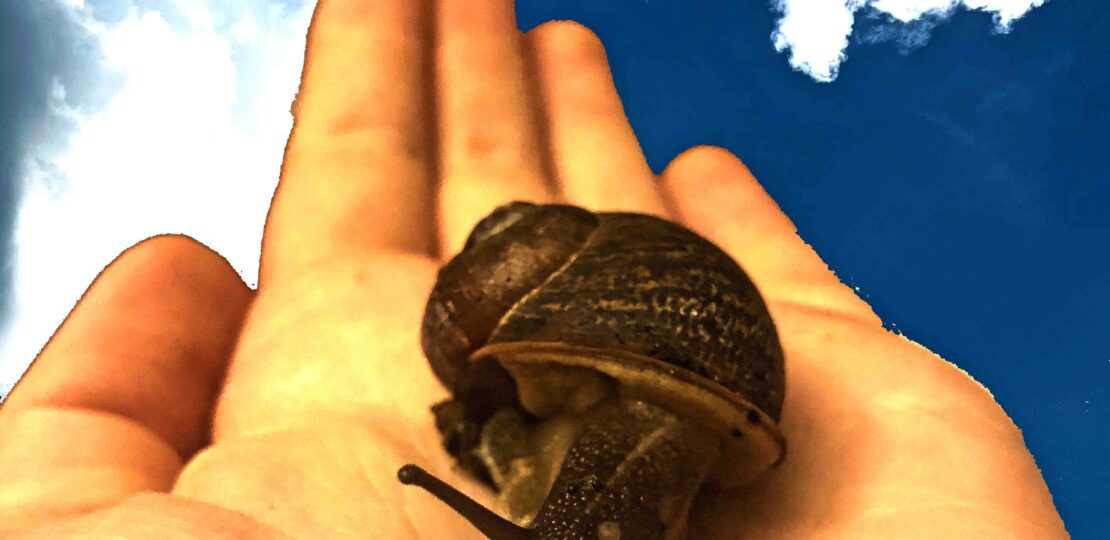
Snails produce a protective slime so thick they can safely glide over razors. This keeps their body moist and their hardcore reputation intact.
My own mental slime involves escaping into details. When the big picture feels too hostile, the complexity of minutiae is an analgesic — a perfect underworld that flickers into being under the beam of my attention. During the pandemic, this coping mechanism intensified into a heady fascination with snails. On lockdown walks I’d linger at every one, follow the shining glyphs they left after rain.
I turn 24 in January 2022, the last of Melbourne-wide lockdowns behind us. My housemates gift me a tantalisingly empty snail tank, street-side snails being scarce in summer. Before February hits I’ve found a source. I walk home, cradling a plastic takeaway container. Inside, gently bubbling, is Agamemnon, Cornu aspersum, a common garden snail. I imagine passers-by wondering about the girl with the snail. I glow.
Snails are hermaphrodites, harbouring male and female organs.
I fall into using he/him pronouns for Agamemnon. If the house is asleep, I can hear the tiny crunches of him eating. When moving across glass the contractions of his body look like undulating bands of light.
Likes: silverbeet, damp, escaping. One nocturnal attempt is thwarted only when I hear him munching on a print I’d just bought. Upon discovery he looks comically sheepish.
Dislikes: bright, hot, the attention economy. When he’s stimulated, his eyestalks gently wave, like kelp. His top speed is 1.67 cm/second. Watching Agamemnon, my mind caramelises.
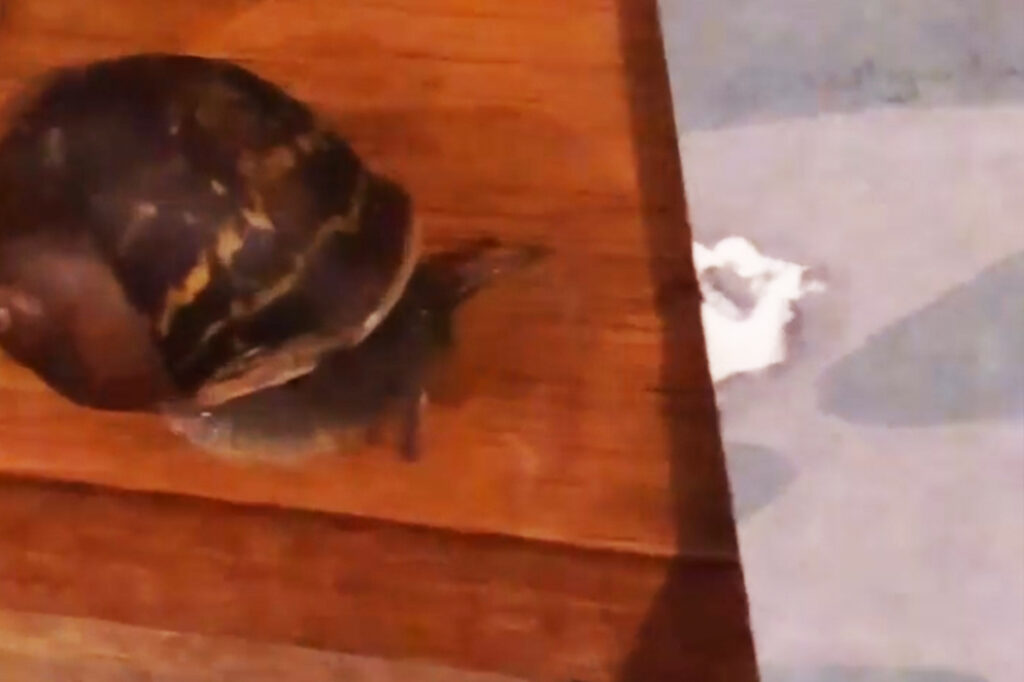
One morning, I lift the lid of his tank and am met, dumbstruck, with an army of translucent baby snails—a miraculous immaculate conception. Each baby is little bigger than a grain of rice, all waving eyes and pearlescent whorls. My housemates and I corral nearly 80 into a snail nursery (snursery), gently hysterical. Panicked Googling reveals that snails can self-fertilize, or store sperm and impregnate themselves later when conditions are favourable. I feel a wave of tenderness— Agamemnon felt safe enough to give birth in my care. Google then deals a blow. Apparently, it’s common practice to cull eggs, or crush hatchlings if eggs escape detection. Releasing babies is ecologically irresponsible and, due to their pest status, illegal.
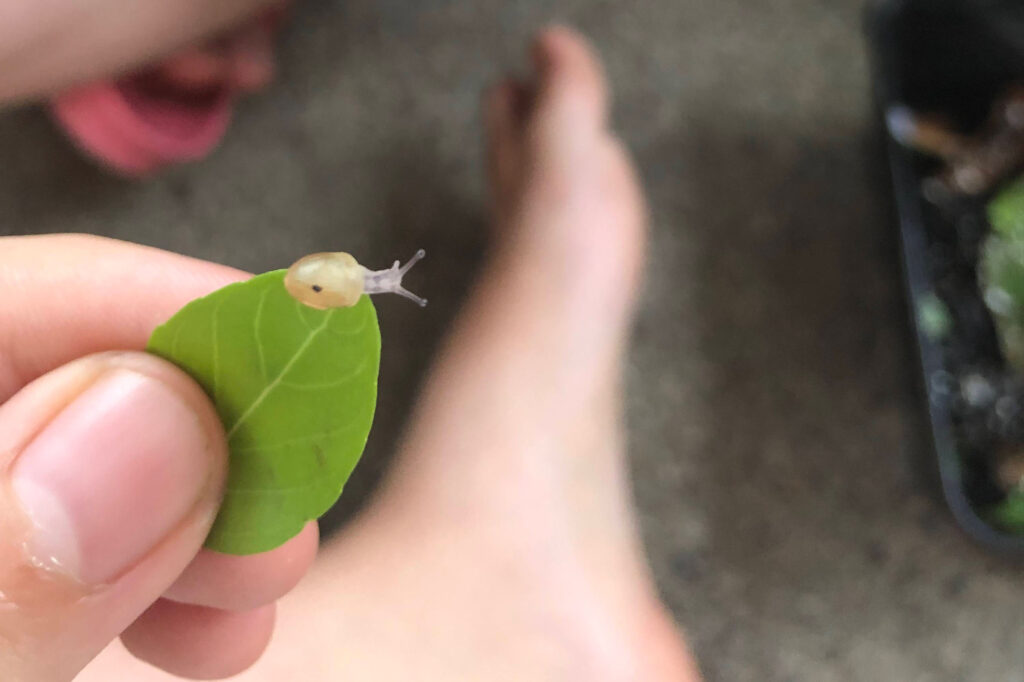
A week oozes past, aqueous with indecision. I can’t kill them. I can’t release. Paralysis building, I neglect the snursery. Start to realise I’d make a bad mother. Too scattered, unregulated, irresponsible. Early Christian art often featured snails, considered symbolic of the deadly sin of sloth. I feel tiny snail ghosts haunting my room, a specific dread that creeps slow and cool against my skin. Eventually, they get under it.
I keep the fastest baby and release the others in a park under cover of night, far fewer than 80 still alive. Walking home, something huge and aching is caught in my throat. The environmentally responsible part of me hopes they’re picked off by birds — the sentimental part visits a week later, hopeful. There’s no life to be found.
Baby Tidbit grows into a clumsy young snail, often falling off things. I baby-proof the tank, removing stones. The snail’s shell is a protective organ, vital as a skull— if it breaks, survival is unlikely. I’ve resolved to be a better parent.
As Tidbit matures, my moral frameworks are mentally readjusted. Nature is wild. Incest happens. In ancient Greek and Japanese cultures, snails represented fertility. Their penises are milky-white, emerge from the neck, and, no surprises, they take hours to have sex.
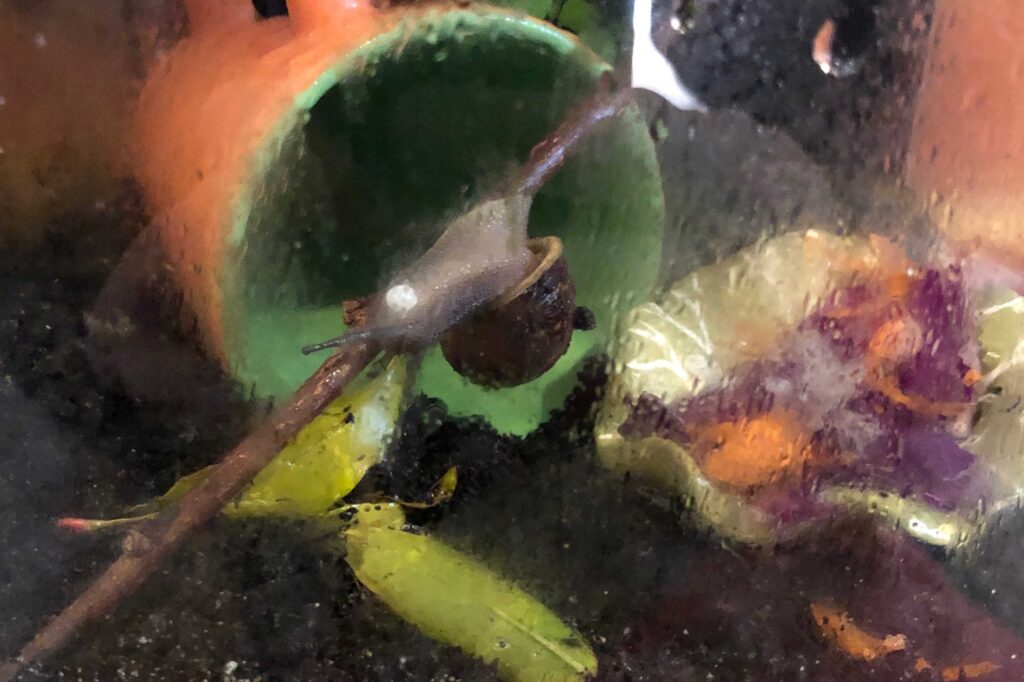
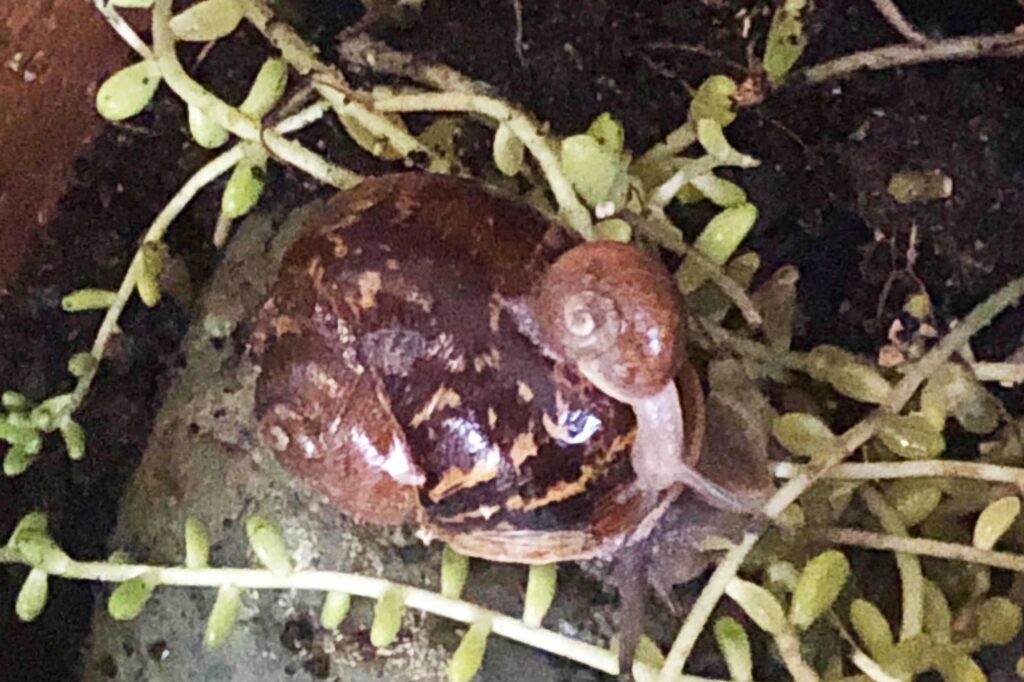
One night a sound scrapes the edge of my hearing. I turn on the lamp to a horrific tableau. Tidbit is curled over Agamemnon, vampirising his shell with her radula, a tongue-like appendage covered in thousands of teeth. Endocannibalism is not uncommon in snails, the shell a rich calcium source, only they usually consume the shells of the dead. I find the hole worn into Agamemnon’s shell and feel sick. This monstrous betrayal is my fault— I haven’t provided enough essential calcium, driving the act. I’m a terrible snail mother (snother). I’ll fuck up any children I have in such an insidious and unutterable way it would be a cruelty to ever birth them.
Agamemnon never really recovers. There’s a rough week where he’s completely lifeless. I discover an ominous crust covering his shell opening and realise he’s dead, and I probably killed him. Barring being squished, most snail species live for 5-15 years. I rest him in a shallow grave, then am suddenly possessed by a fear of being buried alive. No harm in waiting a little. I gently cover him with a leaf. At dusk, I head outside into light rain. The grave is miraculously empty.
I remember with a giddy rush that Agamemnon was born wild, and I’ve been keeping him in captivity. What if he’s been depressed, not dying? When under stress, snails can plunge into suspended animation. I find him exploring a succulent with an old enthusiasm I’d missed and can’t bear to move him. The next morning he’s gone. A bird might’ve got him—I imagine the shell’s crunch an avian delicacy akin to cracking caramel on crème bruléé— but he could be anywhere. I like to think that the richness of the wild, the smell of rain, these are worth a swifter death than if I’d kept him fat and close. I’m learning a hard and clichéd lesson all parents learn— you raise them to leave.
Love enough to let go.
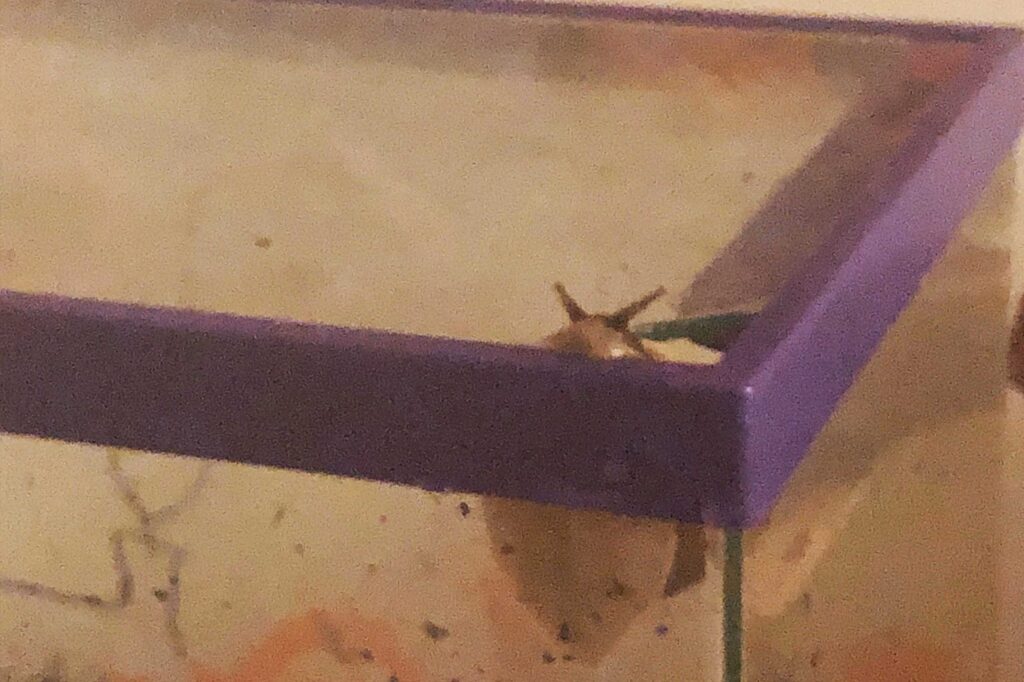
Maybe all parents are winging it, frantically Googling, fighting anxiety with the simple joys of coexisting with a little alien. Tidbit and I settle into a rhythm. Either I’m getting the hang of snothering, or she’s much less dramatic than Agamemnon. Occasionally she peers from the tank as far as her bulk allows, and I think I’ll have to release her too, eventually.
But she brings me the kind of slow joy I’ve felt vaporising as life has sped back up post-pandemic. Time moves differently with Tidbit. Intimacy with this little alien pulls me out of my head and grants gentle access back into the world. Reminds me, again and again, that the big and significant are contained in the small and insignificant.
And when I do handle her, feeling her cool weight inch across my palm, her eyestalks wave. She knows my scent.
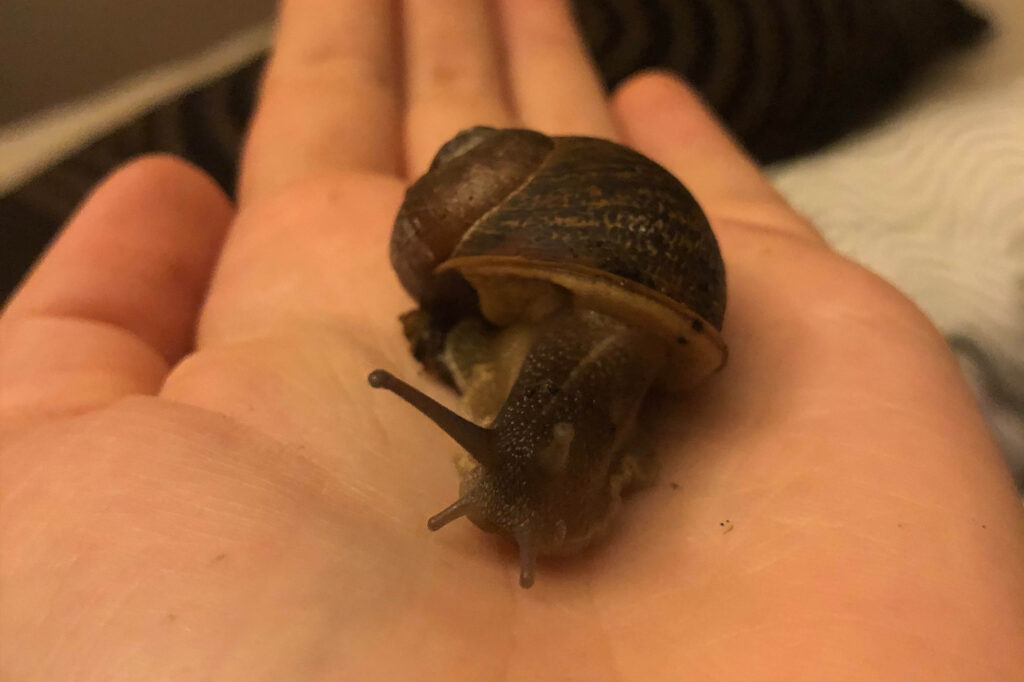
We play a game— she will cross my hand to be closer to me. I rotate my palm so that she’s turned away. She turns around, glacially, to face me again. Each lap might take five minutes or so. It’s a wonderful waste of time.
Words and images by Bridget Webster
Instagram: @bridget.web
RELATED POSTS
View all


